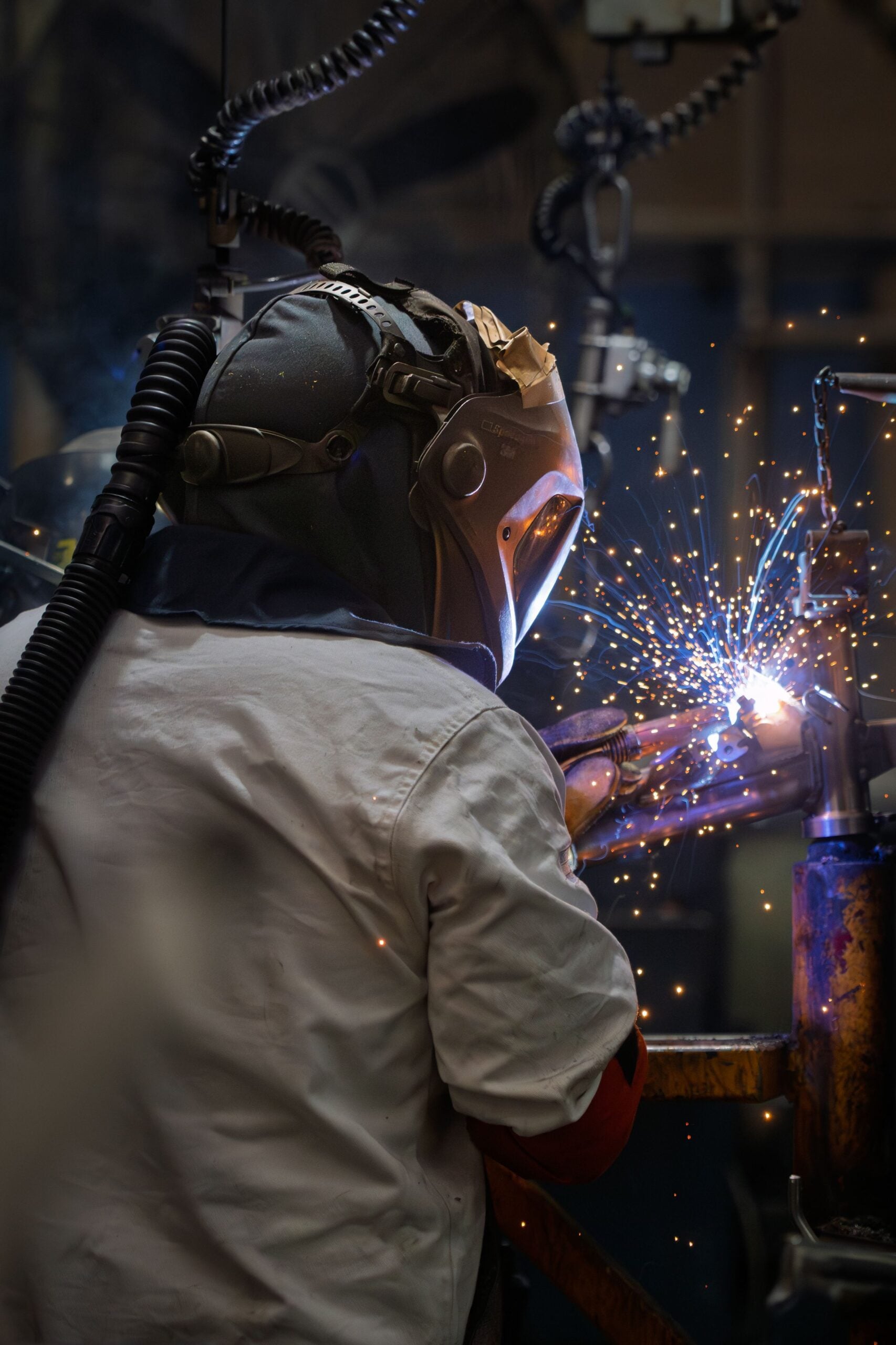
When you send a welding job out, you need more than parts that look good when they come back. You also need the welds to hold, dimensions to meet the print, and parts to arrive when you expect them.
Meeting these expectations can be challenging when you require hundreds of identical parts, and you’re on a tight production schedule.
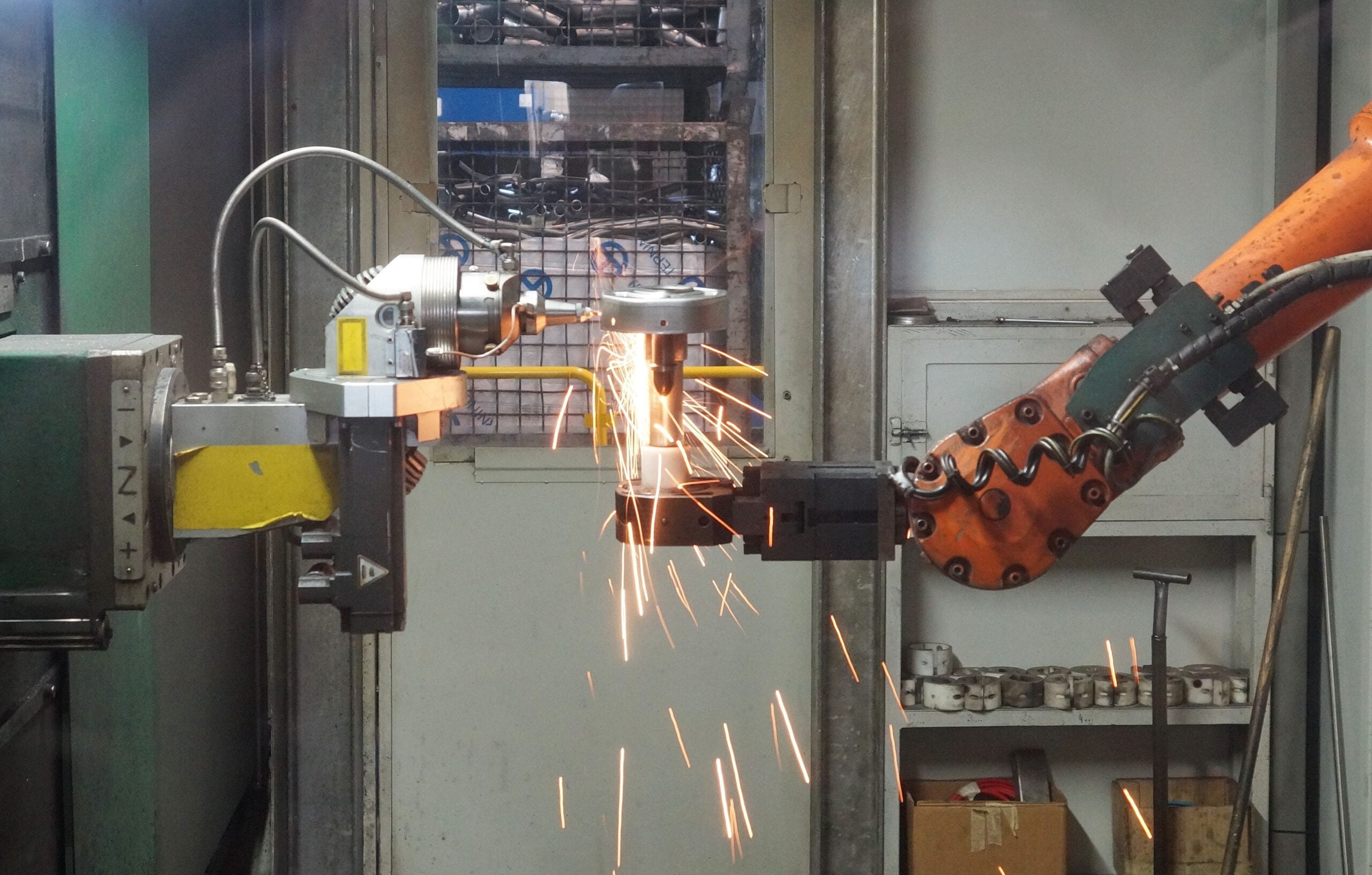
Robotic welding in metal manufacturing helps fabricators handle those jobs with consistent welds and predictable production.

How Does Robotic Welding Improve Weld Consistency?
A skilled welder can produce excellent work, but no person moves exactly the same way every time. Many slight variations in torch angle or travel speed can mean that by the time a stack of matching parts has been finished, the welds aren’t so consistent.
Robot welding systems have repeatable performance. Once a job has been set up and programmed, the system will follow the same path at the same speed for each part.
The robot still needs a good setup. And this requires a few key components: clean fit-up, proper fixturing, and correct welding process settings (e.g. wire, volts, amperage, arc length, travel speed, etc.). In precision robotic welding, all of these must be configured correctly to create consistent welds, part after part.

Can Robotic Welding Speed Up Production?
For the right job, yes. Robotic welding technology can keep moving through repetitive work at a steady pace.
Think about an order that calls for hundreds of similar assemblies. A manual welder would have to carefully maneuver the torch, make the weld, then carefully reposition the torch and make another weld, and so on, over and over again throughout their shift. Their production speed is bound to fluctuate over the course of the day.
Meanwhile, industrial robots can consistently repeat a welding cycle with very little variance in pace. This can shorten cycle times and help move parts through production more efficiently.
So, in which cases does robotic welding make the most sense? Robotic welding is best for high-volume, high-repetition jobs. On the other hand, a skilled welder may be the better fit for unique assemblies, repairs, or jobs that see frequent changes between parts.

Can Welding Automation Help Reduce Waste and Rework?
Scrap and rework eat into a production schedule pretty quickly. Time-consuming welds that require grinding and rework can cause delays in the next process in line.
Robotic arc welding uses programmed movements and welding parameters to apply the weld consistently. Once the process is dialed in, the system can repeat it across a production run.
Consistent welding can also help control how much filler metal gets deposited. Putting down more weld than the job requires uses additional material and can add unnecessary heat to the part.
With welding automation, a shop can spend less time fixing welds and get better control over material use.
How Does Robotic Welding Affect Workplace Safety?
According to the Occupational Safety and Health Administration, welding operations can expose workers to hazards including metal fumes, ultraviolet radiation, burns, eye damage, and electrical shock.
Metal fabrication automation can put some distance between employees and those hazards. Instead of manually performing every weld, employees can handle tasks such as loading parts, overseeing the cell, and monitoring production.
However, robotic systems still need guarding, proper ventilation, training, and safe work practices.
Can Robotic Welding Help Keep Production on Schedule?
When welded parts have to be finished before the next stage of production can start, timing counts. Robotic welding can help keep the order moving at a steady pace.
Once the job is running, the shop knows roughly how long each welding cycle takes and what the cell can handle during a shift. Crews can plan around those numbers instead of guessing how long a batch will take.
On recurring orders, robotic welding can handle the repeat work while skilled welders focus on jobs that need more hands-on attention. This helps the shop stay on top of customer deadlines without tying up welders on the same job all day.
Does Robotic Welding Make It Easier to Scale Production?
Imagine you start with a smaller order and demand grows. Suddenly, you need significantly more of the same part.
A fabricator already using welding automation solutions may be better prepared to handle that increase. Once a repeatable part has a proven program, fixture, and process, the shop doesn’t have to start from scratch every time another batch comes through.
Manufacturing process automation helps a shop build repeatability into production. As your orders grow, your fabricator has an established process and the capacity to keep up.
Where Is Robotic Welding Technology Headed?
Newer robotic welding systems are bringing a few more tools onto the shop floor:
- More production data: Shops can track welding information and catch changes that may need attention.
- Better monitoring: Sensors and software can help crews keep an eye on welding conditions while a job is running.
- Smarter process controls: Newer welding systems can use sensor data and software to help teams identify process changes and address potential issues sooner.
These welding robotics trends don’t eliminate the people behind the process. Someone still has to understand the material, choose the welding process, set up the job, and inspect the work.
The future of robotic welding will give experienced fabrication teams more information to manage production.
When Should You Choose a Fabricator With Robotic Welding Capabilities?
Robotic welding makes the most sense when a job has enough repetition for automation to pay off. High-volume parts and recurring orders with repeatable weld locations are strong candidates.
Even if every project doesn’t require a robot, working with a fabricator that offers robotic welding gives you more room as production needs change.
At Fluid Power Support, we work with manufacturers across industries and choose the process that fits the part, volume, and job requirements.
Running repeat parts at production volume? Let’s talk about how robotic welding can help you move them through production faster and with the consistency you need.
Frequently Asked Questions
Can robotic welding be used for low-volume production?
It can, but robotic welding is generally most beneficial when there is enough production volume to justify the programming and setup required. Low-volume, custom, or frequently changing assemblies may be better suited for manual welding.
What are the benefits of choosing a fabricator with robotic welding capabilities?
A fabricator with robotic welding capabilities can offer consistent welds, predictable cycle times, reduced rework, and greater capacity for repeat production. It also gives manufacturers more flexibility if order volumes increase over time.
How can robotic welding help with large production orders?
Once a repeatable welding process has been established, a robotic welding system can perform the same welding cycle consistently across a large batch of parts. This can help fabricators maintain steady production rates and meet deadlines on high-volume orders.