Nothing slows a shop down faster than parts that don’t fit. You can have the best blueprints and the tightest assembly schedule in the world, but if the parts don’t fit together just right, everything comes to a standstill.
Turning flat steel into usable components doesn’t happen by accident. It takes controlled force, the right setup, and a solid understanding of how metal reacts under pressure. Metal bending and forming turns sheets and plates into accurate components.
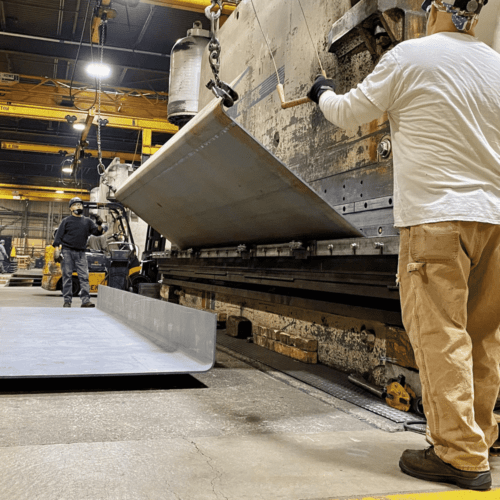
A press brake bends sheet metal by pressing the workpiece between a punch and die. The material, tooling, machine setup, and bend specifications determine how the finished part takes shape.
How Does a Press Brake Machine Bend Sheet Metal?
A press brake uses force to bend a metal workpiece between a punch and die.
The punch sits above the workpiece, while the die supports it from below. During the bending cycle, the punch lowers and forces the metal into the die opening until it forms the required angle.
One common method is air bending. The metal contacts the tip of the punch and two points along the die rather than being pressed completely against the inside of the die. The depth of the punch into the die opening helps control the resulting angle.

What Factors Affect Press Brake Bending?
Metal has its own ideas about what it wants to do under pressure. Different materials, thicknesses, and part designs can change how a workpiece behaves during metal forming.
Several factors influence the finished part:
- Material type: Mild steel, stainless steel, and aluminum have different strengths and forming characteristics that affect the force and setup required.
- Material thickness: Thicker material generally requires more force and can affect tooling selection, die opening, and bend radius.
- Bend angle and radius: Different angles and radii can require different tooling and machine settings.
- Tooling: Punch radius, die opening, and tooling configuration influence the finished geometry and help reduce cracking or unwanted marking.
- Grain direction: Bending with or across the material grain can affect how the workpiece responds and its susceptibility to cracking.
- Springback: Metal naturally moves toward its original position after the bending force is removed. Operators account for this movement to achieve the required angle.
Successful sheet metal forming starts with understanding how these variables work together.

Why Does Press Brake Setup Matter?
A press brake machine can apply a lot of force, but force alone won’t produce accurate components. The machine must be set up for the specific material and part.
The operator has to review the print for dimensions, bend locations, angles, and tolerances before selecting the punch and die, setting up the machine, and positioning the backgauge for each bend.
Bend sequence is also important. Components with several bends have to be formed in an order that allows the workpiece to be repositioned without previously formed sections interfering with the machine or tooling.
Careful setup helps turn the power of a sheet metal press brake into consistent, usable parts.
How Does Modern Press Brake Technology Improve Accuracy?
Press brake technology has come a long way from manual measurements, mechanical stops, and repeated adjustments.
Modern CNC press brakes give fabricators more control over the bending process. CNC controls can manage machine positioning and store parameters for repeat jobs, while programmable backgauges help position material for multiple bends.
Some systems may use multi-axis backgauges, offline programming, or technology that compensates for machine deflection during longer bends. These capabilities help fabricators handle complicated components while improving consistency and reducing setup time.
That control and repeatability make the press brake useful for one-off parts as well as ongoing production runs.
Why Does an Experienced Press Brake Operator Still Matter?
A skilled press brake operator understands what happens when the drawing on the screen meets an actual piece of metal. Material variation, thickness, grain direction, tooling condition, and part geometry can all influence the way a workpiece behaves.
Operators watch for inconsistent angles, incorrect flange dimensions, cracking, and other signs that something needs attention. They can make adjustments before an issue carries through an entire run. Experienced operators pay attention to how the metal is behaving at the press brake.
Even the best press brake technology can’t take every surprise out of the metal. One study in the Journal of Manufacturing Processes demonstrated how variations in material properties can affect springback during bending.
In other words, the numbers can look right on paper and the metal can still behave a little differently once you start bending it. An experienced operator knows how to spot those variations and make adjustments that help keep the final bend angle and finished part within specification.
Technology gives fabricators better tools. Experienced people know how to put those tools to work.
Where Does Metal Bending and Forming Fit Into the Fabrication Process?
A bend is often one stop in a much larger manufacturing process.
A project can begin with a flat sheet or plate that needs to be cut to size. After bending, the workpiece may move on to welding, assembly, finishing, or other fabrication operations.
Accuracy matters because every step builds on the one before it. If a flange is positioned incorrectly, components may not line up during welding. If an angle is off, mounting points may not land where they should. One inaccurate bend can create problems farther down the production line.
Looking at the complete component helps fabricators account for bend locations, tooling access, weld requirements, and how the finished part will be used.
Metal Bending and Forming With Fluid Power Support
At Fluid Power Support, we know a formed component has a job to do after it leaves our facility. It may need to line up with another part, fit into a larger assembly, move into welding, or head to the next stage of production. Getting it right matters.
Our team supports metal bending and forming as part of broader metal fabrication and manufacturing projects. With an experienced team, modern fabrication equipment, and capabilities that extend into welding, metal finishing, and design, we can help move a project through multiple stages of production.
We take the same approach to the work that we’ve built our business around: understand what you need, pay attention to the details, and produce quality work you can count on.
Need metal bending and forming for your next production run or custom fabrication project? Contact Fluid Power Support to talk through your specifications and see how our team can help get the job done right.
Frequently Asked Questions
What types of metal can be bent with a press brake?
Press brakes can form a variety of metals, including mild steel, stainless steel, and aluminum. The material type, thickness, and required bend determine the tooling, force, and machine setup needed for the job.